Corps Pur Et Mélange Exercices Corrigés
Okay, imagine this: I'm in the kitchen, attempting (and I use that word loosely) to make a "healthy" smoothie. I chuck in a banana, some spinach that's definitely seen better days, a splash of almond milk… and then I accidentally add a whole heap of salt instead of sugar. Yuck! My smoothie is *definitely* a mixture. A disastrous one, but a mixture nonetheless. And that, my friends, is a surprisingly good segue into our topic for today: Corps purs et mélanges!
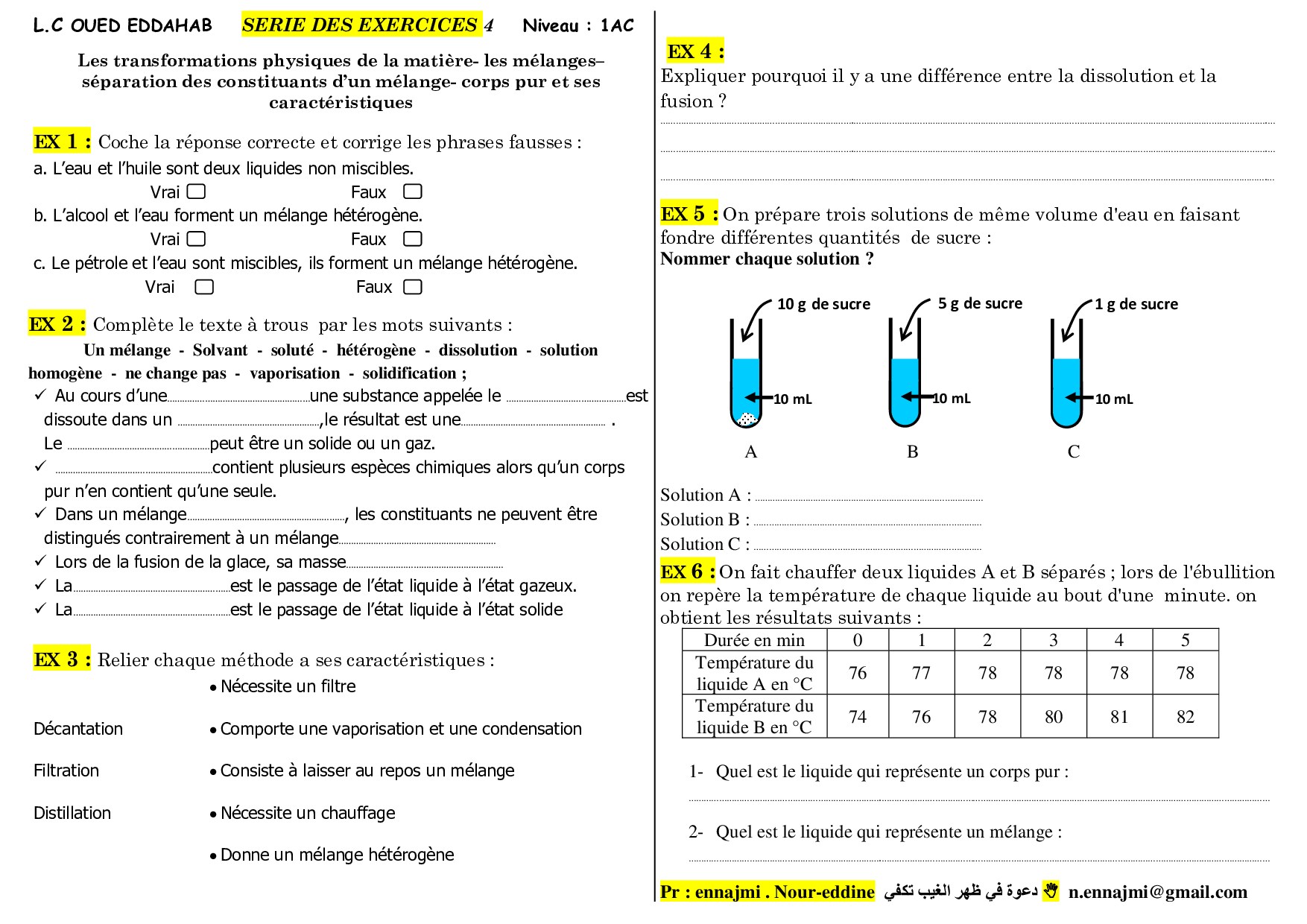
Yes, we're diving into the fascinating world of chemistry, specifically those tricky exercises about pure substances and mixtures, and more importantly, how to *actually* solve them. I know, I know, the very words might send shivers down your spine. But trust me, it's not as scary as my salty smoothie.
What are Corps Purs and Mélanges Anyway?
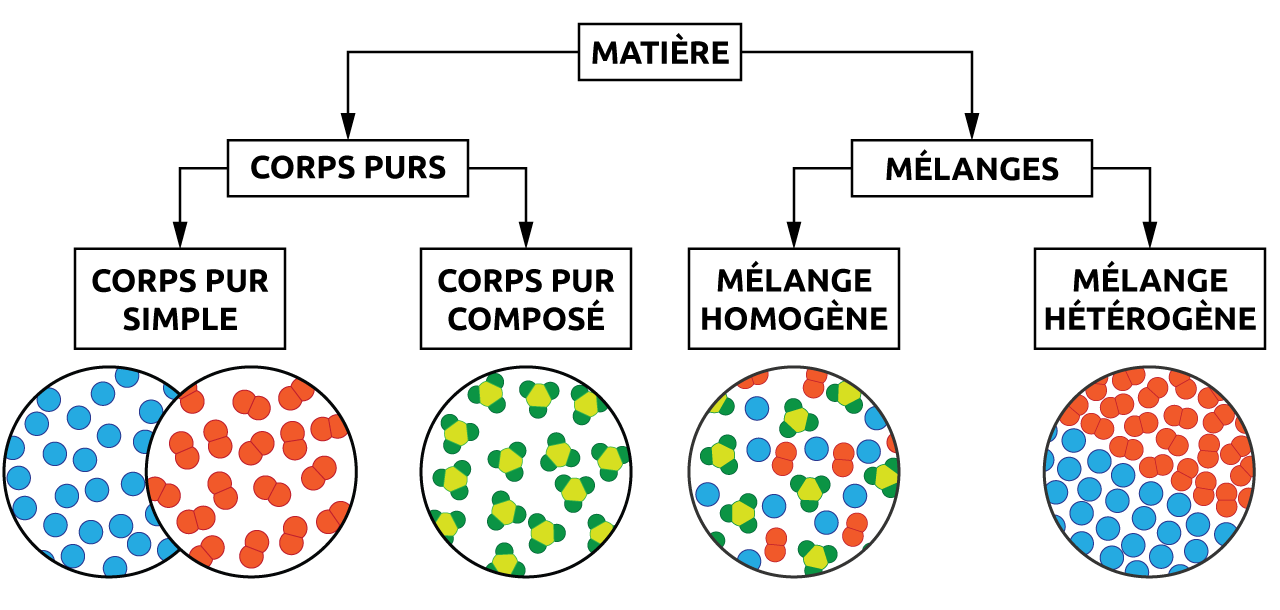
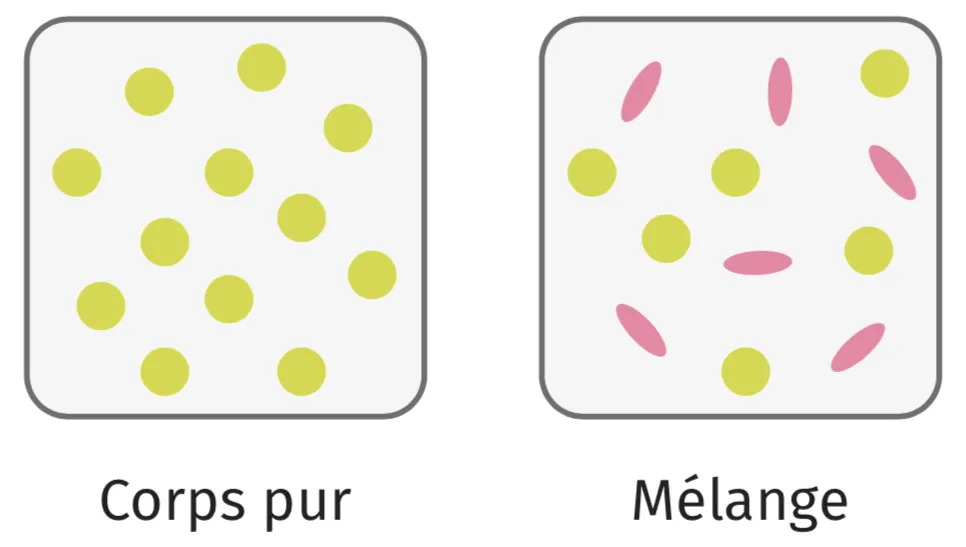
Let's get the definitions out of the way. A corps pur, or a pure substance, is, well, pure. It's made up of only one type of molecule or atom. Think distilled water (H₂O only) or pure gold (Au only). Simple, right?
Now, a mélange, or a mixture, is a combination of two or more different substances that are physically combined but not chemically bonded. So, they can be separated! My salty smoothie? A mixture! The air we breathe? A mixture! Your favorite cup of coffee? You guessed it: a mixture!
Side note: sometimes figuring out if something is pure or a mixture can be a bit tricky. Don't be afraid to ask for clarification! Your teachers will appreciate it. *wink*
The Exercises: Cracking the Code
Okay, now for the fun part: tackling those exercises. The key is to understand the different types of mixtures: homogènes (homogeneous) and hétérogènes (heterogeneous).
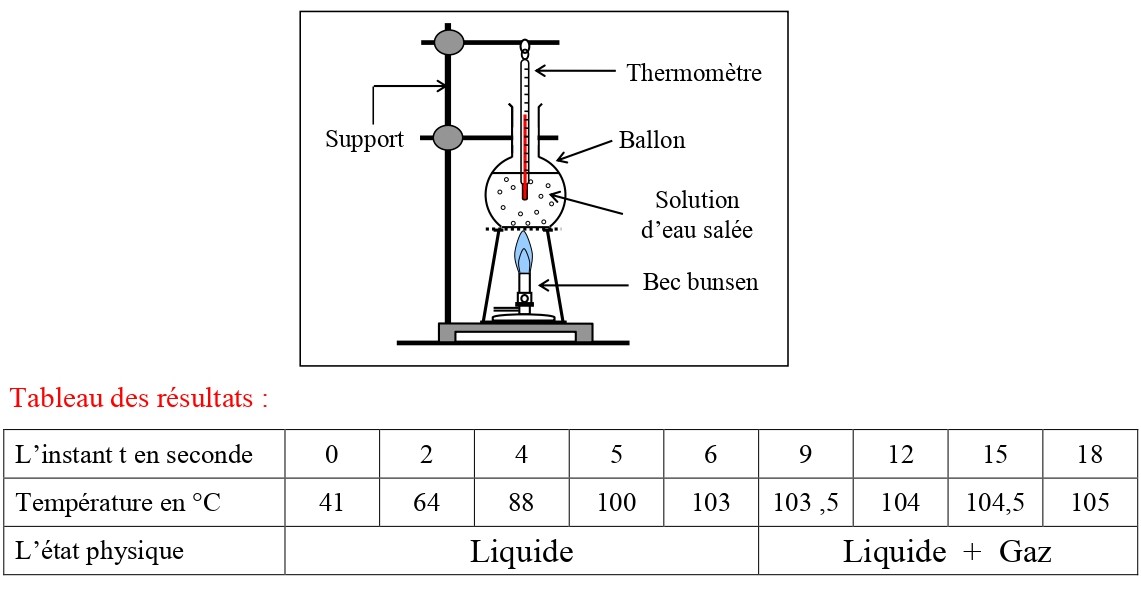
Homogeneous mixtures are uniform throughout. You can't see the different components with the naked eye. Think saltwater or a well-mixed cup of tea. The salt is completely dissolved, right? You can’t see it floating around. In exercise context, it often involves finding the concentration of a solution.
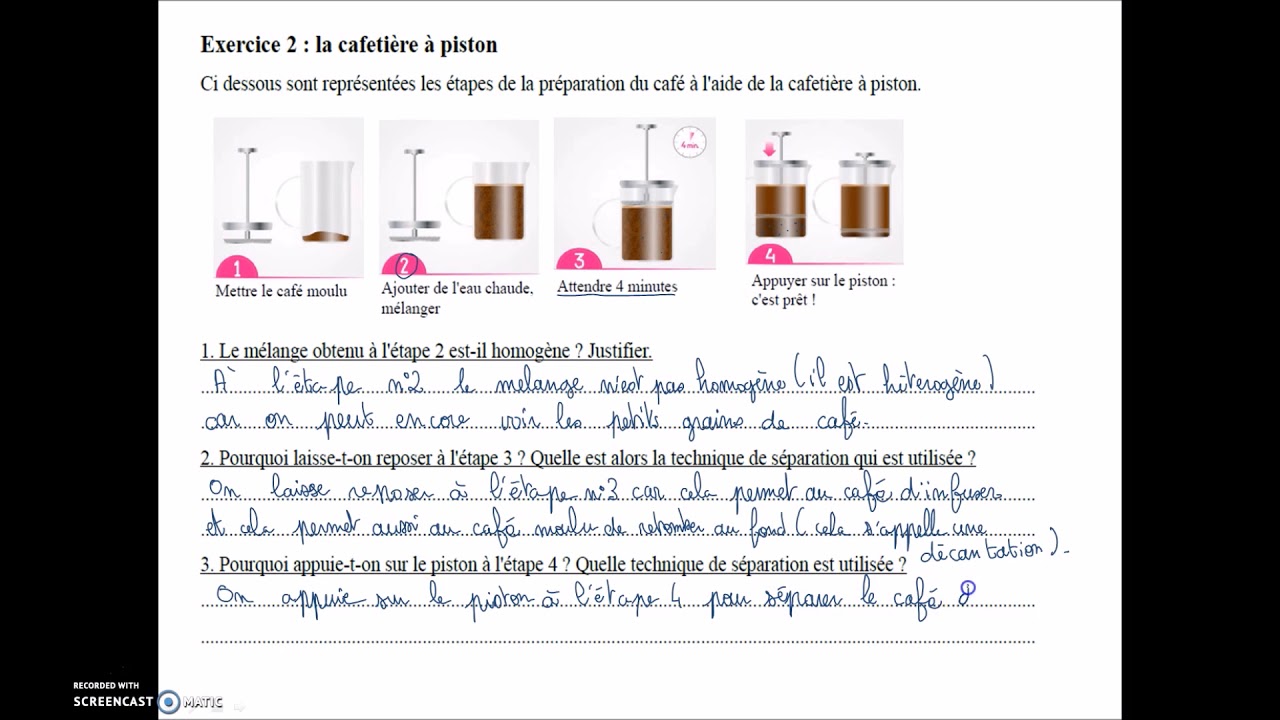
Heterogeneous mixtures, on the other hand, are not uniform. You can easily see the different components. Think salad dressing (oil and vinegar separate), or my (in)famous salty smoothie (bits of spinach everywhere!). These problems are typically about separation techniques.
Examples and Techniques (with a dash of irony!)
Let's look at a typical exercise: "Describe how you would separate a mixture of sand and iron filings."
The answer? Use a magnet! Iron is magnetic, sand isn't. Problem solved! See? Not so scary! These questions are often easier than they seem at first glance. Just think logically.
Another common one: "What type of mixture is muddy water? Suggest a method to clarify it."
Muddy water is a hétérogène mixture. The solution? Filtration! Use a filter paper to trap the solid particles (mud) and let the water pass through. Voila! Clarified water. (Though, I wouldn’t recommend drinking it!)
Remember to always read the question carefully! Pay attention to keywords like "separate," "identify," "homogeneous," and "heterogeneous." These are your clues!
Common Pitfalls and How to Avoid Them
One common mistake is confusing a compound with a homogeneous mixture. Table salt (NaCl) is a compound (chemically bonded), while saltwater is a homogeneous mixture (physically combined). Distinguish between chemical bonds and physical mixing!
Another pitfall? Overcomplicating things. Sometimes the answer is simpler than you think. Trust your intuition, and don't be afraid to draw diagrams to visualize the problem. I know, it sounds silly, but it works!
Resources and Practice
The best way to master these concepts is to practice! Look for online resources with exercices corrigés (corrected exercises). This allows you to see how the problems are solved step-by-step. Seriously, it's a game-changer!
And don't be afraid to ask for help! Talk to your teacher, your classmates, or even your friendly neighborhood chemistry blogger (that's me!).
So there you have it! Corps purs et mélanges, demystified. Now go forth and conquer those exercises! And please, for the love of all that is holy, avoid making salty smoothies.